Specialized Ophthalmology in Seoul · Dedicated International Patient Concierge
MOHW Registered · Foreign Patient Care
en-US


Cataract Care · Needs Clinic Confirmation
Posterior Capsule Opacification Treatment
Posterior capsule opacification (PCO) is a common phenomenon in which vision that was clear after successful cataract surgery becomes cloudy again months to years later — not a true recurrence of cataract, but a build-up of residual lens epithelial cells on
Schedule a ConsultationPosterior Capsule Opacification Treatment

Medically reviewed by Dr. Cha Deok Sun, Director, Ophthalmologist (Ph.D.), board-certified, Korean Ophthalmological Society
Posterior capsule opacification (PCO) is a common phenomenon in which vision that was clear after successful cataract surgery becomes cloudy again months to years later — not a true recurrence of cataract, but a build-up of residual lens epithelial cells on the posterior capsule, the thin membrane bag that holds the intraocular lens in place. At Jamsil Samsung Eye Clinic in Songpa-gu, Seoul, this is treated with a brief, roughly five-minute outpatient YAG laser procedure.
What Is Posterior Capsule Opacification Treatment?
PCO is sometimes informally described as a "secondary cataract," but this term can be misleading since it is unrelated to the original lens tissue that caused the first cataract; the clinic's evaluation is what clarifies this distinction for each patient rather than relying on informal or imprecise terminology.
PCO treatment clears the clouded posterior capsule using a laser rather than repeating cataract surgery.
A specialized neodymium-doped yttrium aluminum garnet (Nd:YAG) laser, focused through a contact lens onto the clouded posterior capsule, fires precise micro-pulses to create a central opening in the optical axis.
The procedure involves no physical incision and no contact with the artificial intraocular lens already in place.
PCO can develop months to years after an otherwise successful cataract surgery and is a recognized, common late finding rather than a sign that the original surgery failed.
Because the laser creates a permanent opening in the cloudy capsule, PCO generally does not recur in the treated opening.
Same-day discharge is standard, following the brief laser procedure and an eye-pressure check.
Who Performs PCO Treatment at Jamsil Samsung Eye Clinic

Because PCO can present at any point during long-term post-cataract follow-up, having a surgeon familiar with a patient's original cataract surgery evaluate any later capsule clouding adds useful continuity to the diagnosis and treatment plan.
Dr. Cha Deok Sun, a director at Jamsil Samsung Eye Clinic, is a board-certified ophthalmologist with a Ph.D. in medicine whose core specializations are presbyopia surgery, cataract surgery, and vision-correction surgery. He completed his ophthalmology residency at Korea University Hospital and a cornea and cataract fellowship at Seoul National University, giving him direct experience with the full range of post-cataract conditions, including PCO, that can arise after lens-implant surgery. He is a full member of the Korean Ophthalmological Society, the Korean Society of Cataract and Refractive Surgery, the American Society of Cataract and Refractive Surgery (ASCRS), and the European Society of Cataract and Refractive Surgeons (ESCRS).
Who Is a Good Candidate for PCO Treatment
PCO is common enough that many cataract-surgery patients will encounter it at some point after their original procedure, sometimes years later, and its onset is not tied to how the original surgery was performed — it reflects a normal biological response of residual lens epithelial cells on the capsule rather than a technique-related issue with the initial operation.
Patients who had cataract surgery months to years earlier and are experiencing renewed blurring of vision that was previously clear.
Patients whose eye examination confirms that capsule clouding, rather than another eye condition, explains their reduced vision.
Not suitable or requiring postponement when visual symptoms are caused by a different eye condition — an eye examination is required to confirm PCO is actually the cause before treatment.
What to Expect: Procedure, Recovery, and Results Timeline

The visit follows four steps: a pupil-dilation exam; topical anesthesia using numbing eye drops; a brief, roughly five-minute outpatient YAG laser procedure that clears the clouded posterior capsule; and an eye-pressure check before discharge home. The laser itself uses only topical (eye-drop) anesthesia — there is no injection and no incision. Same-day discharge is standard once the post-procedure eye-pressure check confirms it is safe to leave.
Visual improvement can occur soon after the procedure, and because the laser creates a permanent opening in the cloudy capsule, PCO generally does not recur in the treated area. Before treatment, the eye is examined, and dilating or other ophthalmic drops may be used as part of preparation. After treatment, eye drops may be prescribed, and follow-up may be recommended to check eye pressure and healing; patients should follow the treating ophthalmologist's specific instructions, since exact aftercare can vary slightly based on individual findings.
International Patient Considerations
International patients experiencing renewed blurring of vision after a previous cataract surgery — whether that surgery was performed at this clinic or elsewhere — can generally have PCO evaluated and treated in a single, brief visit, since the diagnostic exam and the roughly five-minute laser procedure itself do not require the extended recovery window associated with surgical procedures. Patients traveling specifically for this treatment should still allow time for the pupil-dilation exam beforehand and the post-procedure eye-pressure check afterward, and should expect some temporary light sensitivity or blurred near vision from the dilating drops for several hours following the visit. Bringing records of the original cataract surgery, including the IOL model implanted, can help the clinic confirm quickly that PCO — rather than a different post-cataract condition — is the correct diagnosis before treatment.
Safety, Precision, and Clinic Standards
The Nd:YAG laser used for PCO treatment is a well-established, non-incisional technology that creates a small, precise opening in the clouded capsule without touching or displacing the intraocular lens already in place. Recognized risks include a temporary spike in intraocular pressure, mild intraocular inflammation, and, less commonly, retinal detachment, displacement or minor laser markings on the artificial lens, and macular edema; the post-procedure eye-pressure check performed before discharge is specifically intended to catch a pressure spike before the patient leaves the clinic. Observation may be appropriate instead of treatment when capsule clouding does not significantly affect vision, since not every case of PCO requires immediate laser treatment — when it is visually significant, YAG laser capsulotomy is the standard treatment rather than replacing the artificial lens itself.
How PCO Treatment Compares to Other Post-Cataract Services
| Condition | What's Happening | Typical Treatment |
|---|---|---|
| Posterior Capsule Opacification | Clouding of the membrane behind the IOL, not the IOL itself | ~5-minute outpatient YAG laser capsulotomy |
| IOL Dislocation/Malposition | The lens itself has shifted | Cataract revision surgery (repositioning or exchange) |
| Residual Refractive Error | Vision not fully corrected after original surgery | IOL replacement or LASIK, depending on cause |
Distinguishing PCO from cataract revision surgery matters for what a patient should expect: PCO treatment is a brief, laser-only outpatient procedure addressing capsule clouding, while cataract revision surgery is a more involved procedure addressing a physical problem with the lens itself. A comprehensive eye examination is what determines which of these — if either — actually explains a patient's post-cataract vision changes.
Why the Diagnosis Matters More Than the Symptom
Patients experiencing renewed blurriness after cataract surgery often assume, understandably, that "the cataract came back," but true cataract recurrence in an eye with an implanted intraocular lens is not how PCO actually works — the natural lens that caused the original cataract has already been removed, and what regrows on the posterior capsule is a separate biological process involving residual lens epithelial cells left behind at the edges of the capsule during the original surgery. This distinction matters practically: because the treatment for PCO (a laser opening in the capsule) is entirely different from any treatment aimed at an actual cataract, an accurate diagnosis at the outset avoids both unnecessary anxiety about "another cataract" and any confusion about what treatment is actually appropriate. The clinic's eye examination is what establishes this diagnosis with certainty, rather than assuming based on symptoms alone that look similar to how a cataract originally presented.
Combining PCO Treatment with Other Treatments
YAG laser capsulotomy is typically performed as a single intervention, but it can be combined with anterior vitreolysis to remove vitreous strands, or with laser iridotomy if concurrent angle-closure risk or intraocular pressure issues are present, allowing related concerns to be addressed in the same visit rather than requiring separate appointments.
Patients sometimes worry that any post-cataract vision change means something has gone wrong, but PCO is better understood as an expected, manageable part of the longer-term cataract-surgery journey for a meaningful share of patients, with a correspondingly quick and low-risk fix, rather than as a setback in their original treatment.
The Bottom Line
Posterior capsule opacification is a common, treatable clouding of the membrane behind an implanted intraocular lens — not a true recurrence of cataract.
Treatment is a brief, roughly five-minute outpatient YAG laser procedure with same-day discharge, not a repeat of the original cataract surgery.
Because the laser creates a permanent opening in the capsule, PCO generally does not recur in the treated area.
Dr. Cha Deok Sun's cataract and cornea fellowship training supports his experience managing this and other post-cataract conditions.
Not every case of capsule clouding requires immediate treatment; observation may be appropriate when vision is not significantly affected.
Frequently Asked Questions
Why does my vision sometimes cloud again years after cataract surgery? This is usually posterior capsule opacification, a build-up of residual lens epithelial cells on the membrane behind the implanted lens rather than a true recurrence of cataract, and it is treated with a brief outpatient YAG laser procedure that typically does not require repeating the original surgery.
Is YAG laser capsulotomy painful? No — the procedure uses only topical (eye-drop) anesthesia, involves no incision, and does not touch the implanted intraocular lens; most patients describe it as quick and largely uneventful, taking about five minutes.
Will posterior capsule opacification come back after laser treatment? Generally no — because the laser creates a permanent opening in the cloudy capsule at the treated location, PCO does not typically recur in that specific opening, though this is separate from any other post-cataract condition that might develop later.
How do I know if my blurry vision is PCO or something else, like a lens problem? An eye examination is needed to confirm the cause — PCO involves clouding of the capsule membrane itself, while a lens-position problem (addressed through cataract revision surgery) involves the implanted lens having shifted; the two require different treatments, so an accurate diagnosis matters before proceeding.
Do I need treatment for PCO if it isn't bothering my vision much? Not necessarily — observation may be appropriate when capsule clouding does not significantly affect vision, and YAG laser treatment is generally reserved for cases where the clouding is visually significant enough to warrant it.
Can PCO happen more than once in the same eye? No — once the laser has created an opening in the clouded portion of the capsule, that specific opening does not become cloudy again; if new visual symptoms develop later, they would reflect a different, separate cause rather than a recurrence of the treated PCO.
Book a Consultation at Jamsil Samsung Eye Clinic
To discuss posterior capsule opacification evaluation and treatment options with Dr. Cha Deok Sun, contact Jamsil Samsung Eye Clinic in Songpa-gu, Seoul, through its online consultation and contact page or by phone at +82-2-424-7523 to arrange an eye examination.
Disclaimer
This page is for general informational purposes and does not constitute individualized medical advice. Diagnosis and treatment recommendations can only be determined through a consultation with a qualified physician.
Sources & Further Reading
Other Services
Explore additional ophthalmology treatments offered by our specialists.

EVO AQUA ICL (Implantable Collamer Lens)
EVO AQUA ICL is a vision-correction procedure in which a specialized corrective lens made of biocompatible Collamer material is inserted directly between the natural lens and the iris, without damaging or reshaping the cornea.
Learn More

Presbyopia Surgery (Clareon PanOptix Pro)
Presbyopia surgery with the Clareon PanOptix Pro trifocal lens corrects presbyopia — the age-related loss of near-focusing ability caused by the eye's lens stiffening and losing elasticity, combined with reduced ciliary-muscle function — by implanting a
Learn More
Presbyopia Precision Exam Program
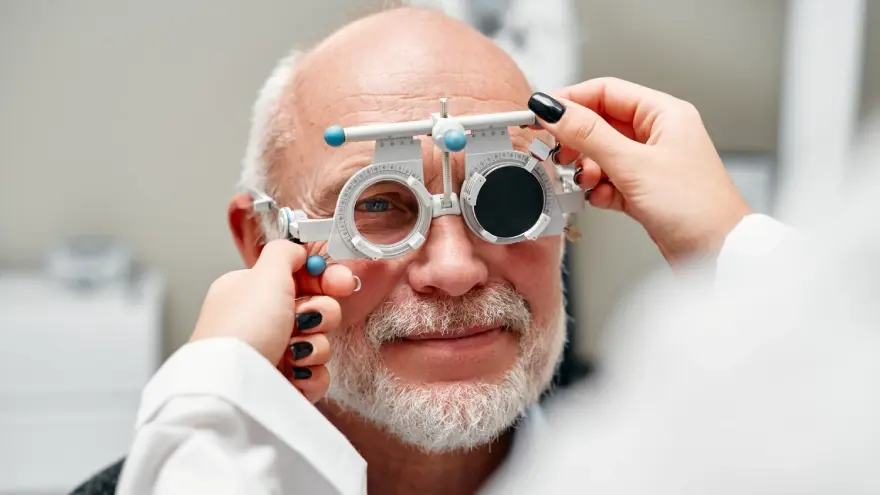
The Presbyopia Precision Exam Program is a specialized diagnostic evaluation designed to thoroughly measure eye health, corneal state, and refractive index before prescribing presbyopia correction or laser vision procedures.
Learn More