Specialized Ophthalmology in Seoul · Dedicated International Patient Concierge
MOHW Registered · Foreign Patient Care
en-US


Medical Guide
Book an Online Consultation: Korea Eye Clinic Guide
Book an online consultation with a Korea eye clinic: the channels this Seoul practice documents, the time-zone arithmetic, and what to assemble up front.
Schedule a ConsultationFirst Contact With a Korean Eye Clinic: The Practical Mechanics
Medically reviewed by Dr. Kim Byoung Jin, Board-certified ophthalmologist (Korean Ophthalmological Society)
Deciding to book an online consultation with a Korea eye clinic is the first step in planning eye surgery overseas, and a smaller step than it feels. You are not committing to a procedure or a date — and no price appears at this stage, because Jamsil Samsung Eye Clinic publishes none in its record and what you pay is settled after an examination.
What you can settle now is mechanics: which channels exist, when a message written in the United States is actually read in Seoul, and what to have ready before you write. Scheduling a LASIK consultation abroad is a sequence with a fixed order, and two of its items — a stable prescription history and a contact-lens washout — start weeks before you book.
The channels this clinic documents, and the one it does not
For patients writing from the United States, the clinic's primary channel is the contact form on its own website. That is not a general-inquiry box: the record routes the online consultation process itself through that form, making the form the mechanism rather than an address. If you have been hunting for the right contact form for a Korean eye clinic, this is the front door.
Alongside it the record lists three routes: telephone consultation, online consultation and reservation, and email reply requests, the last meaning you can ask for a written answer rather than a call. Two telephone numbers are published: +82-2-424-7523, a Seoul landline, and +82 10-2215-7523, a mobile line. Calling either from the United States means prefixing your international access code and catching a phone during Seoul's working day.
One absence deserves naming, because patients often assume it into existence. Nothing in the record documents a video consultation product — no platform, no appointment format, no process for a call with a doctor. That does not mean the clinic would refuse one; it means a video consultation as an international patient is something to ask about rather than plan around. "Online consultation" is the accurate term, and it describes a written exchange.
Doing the time-zone arithmetic once, properly
Seoul sits 13 to 17 hours ahead of the continental United States, the gap depending on which US time zone you write from and where each country sits in its daylight saving cycle. Do that arithmetic once and the rest of the planning gets easier.
The clinic's consulting day runs from mid-morning into the evening on weekdays, pauses for an hour at midday, shortens to a morning-only session on Saturday, and stops on Sundays and public holidays. Push that through the gap and one pattern falls out: a Seoul working day overlaps the back end of a US day, never the front.
Two illustrations. Write at nine on a Monday morning in New York and your message reaches Seoul at ten at night, after the consulting day has closed, and waits until Tuesday there. Write at nine that same Monday evening and it lands at ten on Tuesday morning in Seoul, mid-session, with a full Korean office day ahead of it.
The logic runs west with a wider gap, so from California the productive window is your late afternoon and evening. Two edges: Friday evening in the US is Saturday morning in Seoul, the short session, and anything sent across a US Saturday reaches a closed clinic and waits for Monday.
What a reply cycle costs, and how to write a message that survives it
A round trip across that gap has a floor of roughly one calendar day, and two is common. You write in your evening, Seoul reads it during their day, someone answers while you sleep, and the reply is there next morning.
The bad case is the ordinary one. You send a one-line question. The reply asks something clarifying. You answer. It asks something else. Six exchanges of that kind consume two weeks and deliver what you could have had on day one.
So send one message, built as a document rather than a note. Three things do most of the work:
- Lead with your situation, not your questions. Someone who knows your prescription, lens history, age and travel window can answer questions you did not think to ask.
- Number the questions. A numbered list invites a numbered reply, which is harder to answer partially without the omission showing.
- Ask for the answer in writing. Email reply requests are a documented channel, so a written response is something you can request by name — and re-read later, unlike a call.
The document that matters most is your prescription history
When a clinic asks for your prescription, it is asking for a refraction — the measurement of how your eye bends incoming light and how much correction it needs to focus that light on the retina. In practice it is the numbers on your glasses or lens prescription: a spherical power for nearsightedness or farsightedness, plus a cylinder value and an axis where astigmatism is present.
What the clinic needs is not a refraction but the history of them. Its documented candidacy requires vision stable for roughly six months, and that you are 18 or older. Stability is not something one measurement can show: two readings six months apart can, today's alone cannot.
So run an errand before you write: ask your optometrist or ophthalmologist for copies of your prescriptions going back a few years, not only the latest. What you are assembling is a line you can plot: steady, drifting slowly, or recently moved.
A prescription that shifted in the last few months is a finding, not a verdict — a reason to be measured again later rather than a permanent exclusion. Better to learn that before you buy a plane ticket than in a Seoul examination room.
Contact-lens washout starts at home, not at the airport
If you wear contact lenses, a clock needs to start before you book anything, and it is the item first-time planners most reliably overlook.
A lens sits directly on the cornea and presses against it. Even a well-fitted soft lens leaves the surface slightly altered after a day of wear, and some alter it on purpose. Measurements taken then describe the lens's effect rather than the eye underneath, so a surgical plan built from them would rest on the wrong shape. Lenses therefore come out first and stay out long enough for the cornea to return to its natural contour, at which point measurements are true.
The record sets out how long. Soft lenses stop about a week before diagnostic testing; hard lenses, and toric lenses used for astigmatism, about two weeks before. Orthokeratology lenses — the overnight reshaping lenses also sold as Dream lenses — need three weeks to a month, the longer end depending on the procedure planned.
The consequence for a travel plan is unavoidable. The washout has to be finished when you walk into the examination, so it begins at home, before the flight, sometimes before you have chosen dates. A rigid-lens wearer who stops on landing has paid for a trip in order to be measured on the wrong cornea. Hence the question for your first message: given the procedures plausible for a prescription like mine, how long do I need to be out of lenses?
What to assemble before you write
Gather this first. Having it ready is the difference between a first reply that moves you forward and one that only asks for more.
- Your current prescription and its history. The latest refraction plus earlier ones going back a few years, with dates attached.
- Any previous eye surgery or eye disease. Laser treatment, cataract surgery, glaucoma, retinal problems, keratoconus, or a family history of these.
- Your current medications. All of them, systemic as well as ophthalmic, including drops you use casually.
- Your lens-wearing pattern. Which type, in which eye, how many hours a day and days a week, and when you last wore them.
- What you want vision for. Night driving, screens all day, fine print, contact sports, a job with a vision standard.
- Your available travel window. The dates you could be in Korea, and whether you could return later if needed.
What an online consultation can settle, and what it cannot
An online consultation is genuinely useful, for a narrower band of things than people hope.
It can orient you: which procedures the practice performs and which are plausibly relevant to a prescription like yours, how long a washout you face, roughly what a visit sequence looks like, what to bring, and whether the trip is worth planning at all.
What it cannot do is decide whether you can have surgery. The record is unambiguous: final eligibility for vision correction rests on a comprehensive in-person examination lasting roughly two hours. That includes corneal topography, which maps the curvature of the corneal surface point by point rather than reducing it to one number; measurement of pupil size under different lighting, because a pupil that opens a long way in the dark changes how a correction behaves at night; and an assessment of corneal health. None of that can be done down a wire.
The National Eye Institute describes surgery for refractive errors as reshaping the cornea, or implanting a lens, so light comes to a focus correctly, and notes that results vary between people and that surgery does not halt the age-related change which eventually affects near focus. That is the right frame for a first message: you are asking whether a procedure is plausible, not for a promised outcome.
Language support, and how much of it is confirmed
English support here exists on the record as a structure rather than a set of specifics. Be exact about which is which.
The structure is documented: English-language help handled in house rather than farmed out, spanning the whole arc — first inquiry, consultation, the day of surgery, aftercare, emergency contact. Documents can be supplied in translation, and no language limitation is recorded against its international services.
The specifics are another matter. Three items sit in the clinic's own files awaiting confirmation: who the international coordinator is and what hours that person keeps, how language is handled once you are in the consultation room, and what English support exists for aftercare and emergencies. Put plainly, the clinic documents the door but not what is behind it — the channels are published, while the coordinator, the language flow and the fee schedule are all marked for confirmation.
For a first message that has one implication. Skip the general question about whether English is spoken; the outline answers it. Ask instead for what the outline leaves open: who will handle your correspondence, what hours they work in Korean time, which documents reach you in English, and who you contact in English if something is wrong at ten at night in Seoul.
What the clinic's registrations tell you at this stage, and what they do not
One credential is checkable before you write a word. Jamsil Samsung Eye Clinic holds a status with a long name: Registered Medical Institution for Attracting Foreign Patients. Korea's Ministry of Health and Welfare confers it, acting under a statute known as the Medical Overseas Expansion and Foreign Patients Attraction Act, and that ministry together with the Medical Korea foreign-patient portal forms the official channel for the program. The practice, led by its representative director, describes its own structure on its about page.
Be precise about what that establishes. It is an administrative status: the clinic is permitted to receive patients from other countries, inside a government framework that tracks which institutions do. It is not a clinical audit: no inspector reviewed surgical results to grant it, and it says nothing about a particular surgeon or procedure. It answers whether the clinic may lawfully treat you, not how well it treats people.
The counterweight is the Yellow Book chapter on medical tourism published by the Centers for Disease Control and Prevention. It records that care obtained in another country brings its own risks — communication difficulties, standards that differ between health systems, and gaps in continuity of care when treatment happens in one country and follow-up in another. Registration removes none of them. Nor does the US Department of State's guidance on health abroad soften the position that a traveler carries their own medical costs overseas.
Specialist ophthalmologists in Korea are certified through the Korean Ophthalmological Society — a named body to ask about rather than a credential to accept on trust.
What a good first reply looks like, and what to do if it is vague
You will recognize a useful reply by what it contains, not how fast it arrives. It should include most of the following:
- A named person and a channel, so you know who you are corresponding with and where to write next.
- A direct response to your prescription history, not a general line about candidacy being decided at the examination.
- The washout period for your lens type, tied to the procedures the clinic considers plausible.
- A visit sequence in outline: examination, decision, procedure, checks, and how they sit relative to one another.
- What the examination involves and how much of a day to allow for it.
- Which parts of your visit run in English, named individually.
- What is not yet answerable, and why. A reply saying plainly that something depends on the examination is more trustworthy than one answering everything.
If what comes back is vague — a generic welcome, an invitation to call, no engagement with what you asked — treat it as a first draft rather than a verdict. Reply once, quote your numbered questions, and ask for the items that went unanswered. If a second attempt still returns nothing specific, that is real information: not about the surgery, but about how a question from overseas gets handled when it is urgent.
The Bottom Line
- The documented route is the contact form on the clinic's own site, with telephone consultation, online consultation and reservation, and email reply requests alongside it; no video consultation product is on the record.
- Seoul's clock runs 13 to 17 hours ahead of the continental United States, and its working day overlaps your evening, not your morning; anything sent across a US Saturday waits for Monday.
- Send one complete numbered message rather than a thread of one-liners, and start your prescription history and contact-lens washout before you book, since both run on clocks that begin at home.
- An online consultation orients you; it cannot establish candidacy, which the record places on an in-person examination of roughly two hours covering corneal topography, pupil size under varying light, and corneal health.
Frequently Asked Questions
Does this clinic offer video consultations for international patients?
Nothing in the clinic's record documents a video consultation product — no platform, format, or stated process. What is documented is online consultation and reservation running through the contact form on its website, plus telephone consultation and email reply requests. Ask whether a video call is possible rather than assuming it.
What time of day should I send a message from the United States?
Your evening. Seoul is 13 to 17 hours ahead of the continental United States. A message written during your working day arrives after the Korean consulting day has ended, while one written in your evening lands mid-session. Sunday through Thursday evenings give the clinic a full day to respond.
How long should I expect to wait for a reply?
The clinic publishes no target response time, so plan around the clock rather than a promise. A single question and its answer takes roughly a calendar day at best, because the two working days barely touch, and a chain of short follow-ups can stretch across two weeks.
Can an online consultation tell me whether I am a candidate for LASIK?
No. The clinic's record puts final eligibility on a comprehensive in-person examination lasting about two hours, including corneal topography, pupil-size measurement under different lighting, and an assessment of corneal health. An online exchange can only tell you whether the trip is worth planning.
How far in advance do I need to stop wearing contact lenses?
The record gives about a week for soft lenses before diagnostic testing, about two weeks for hard or toric lenses, and three weeks to a month for orthokeratology or Dream lenses depending on the procedure planned. The point is to let the cornea return to its natural shape so measurements reflect your eye.
Why does the clinic want my old prescriptions and not just the current one?
Because its documented candidacy requires vision stable for roughly six months, alongside being 18 or older, and stability cannot be shown by one measurement. A single current refraction describes today; two separated by six months describe a trend. Requesting copies before you write makes the first reply more specific.
Does the clinic's foreign-patient registration mean the surgery itself is certified?
No. The status is called Registered Medical Institution for Attracting Foreign Patients. Korea's Ministry of Health and Welfare confers it under a statute, the Medical Overseas Expansion and Foreign Patients Attraction Act, and what it grants is administrative permission to receive patients from abroad, not a clinical audit. The CDC separately notes that care obtained in another country brings risks including communication difficulties and continuity-of-care gaps.
This article is for general informational purposes and does not constitute individualized medical advice. Candidacy, technique, and expected outcomes can only be determined through an in-person examination and consultation with a qualified ophthalmologist. It is not a self-diagnosis tool.
More Articles
Continue reading our clinical ophthalmology guides.
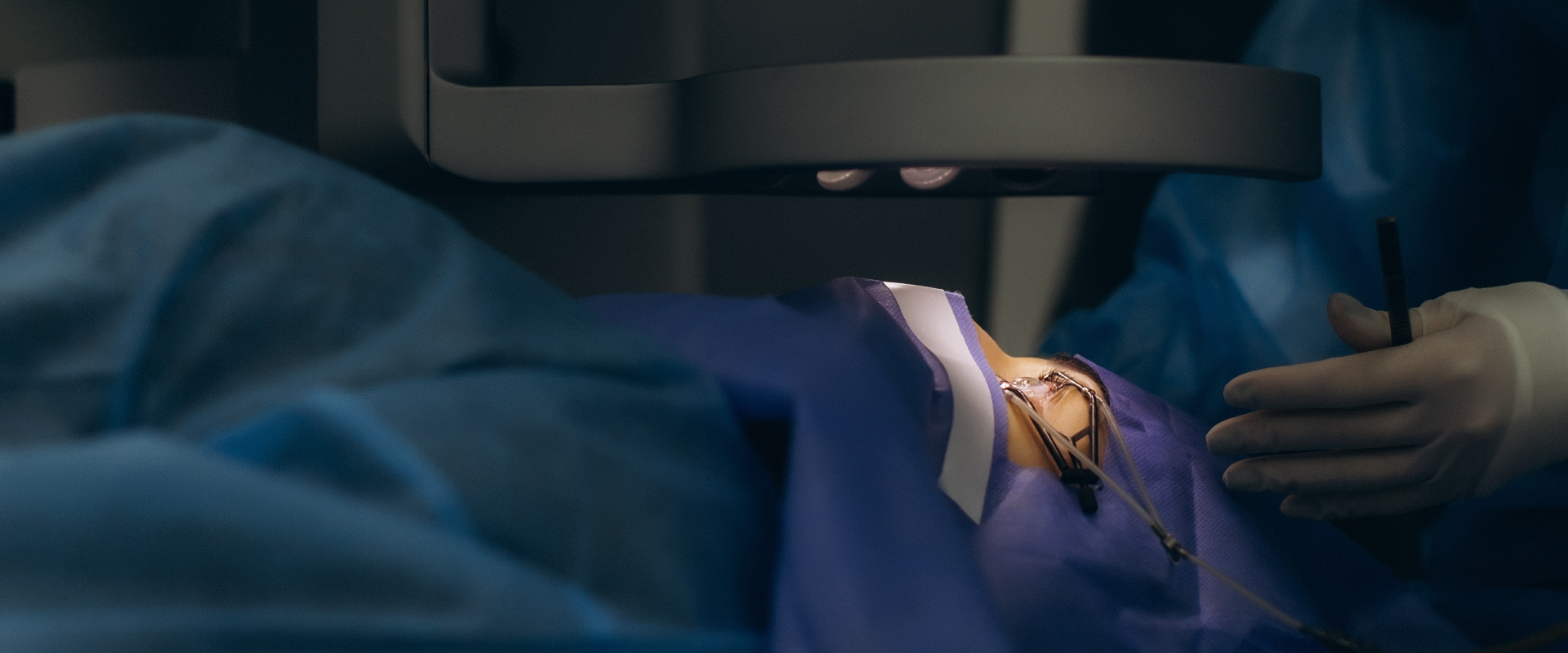
LASIK Cost Korea vs US: How Each System Sets Prices
LASIK cost in Korea vs the US differs because each system treats vision correction as elective. How pricing is structured, and how to request a real quote.
Learn More
Dr. Kim Byoung Jin: Ophthalmologist in Seoul, Korea
Dr. Kim Byoung Jin is a board-certified ophthalmologist and representative director at Jamsil Samsung Eye Clinic, Seoul. His training and focus, explained.
Learn More
Book an Online Consultation: Korea Eye Clinic Guide
Book an online consultation with a Korea eye clinic: the channels this Seoul practice documents, the time-zone arithmetic, and what to assemble up front.
Learn More