Specialized Ophthalmology in Seoul · Dedicated International Patient Concierge
MOHW Registered · Foreign Patient Care
en-US

Medical Guide
Myopia, Hyperopia, and Astigmatism: A Patient Guide
Myopia, hyperopia, and astigmatism explained: how the eye focuses light, what each error does to vision, and how to read the numbers on your prescription.
Schedule a ConsultationUnderstanding Myopia, Hyperopia, and Astigmatism Before Surgery
Medically reviewed by Dr. Kim Yoon Kyung, Board-certified ophthalmologist
Myopia, hyperopia, and astigmatism explained in plain terms come down to a single question: where does the light land? A healthy eye brings incoming light to a focus exactly on the retina. Each of these three conditions is a different way of missing that target, and each one produces a recognizably different experience of blurred vision. The National Eye Institute describes refractive errors as the most common type of vision problem, affecting more than 150 million Americans.
This guide explains the optics, the vocabulary, and the numbers on your prescription. It is the groundwork worth having before any conversation about correction — surgical or otherwise — because every such conversation starts with the measurement, and the measurement is much easier to discuss once you know what it is describing.
How a healthy eye focuses light
Light does not travel through the eye in a straight line. It is bent, and the bending is what produces an image.
The National Eye Institute puts the mechanism simply: refraction is the bending of light rays as they pass from one object into another, and in the eye it is the cornea and the lens that bend light rays in order to focus them on the retina. The cornea — the clear front layer of the eye — does most of that work. The FDA's own patient glossary describes the cornea as the first part of the eye that bends light and states that it provides most of the focusing power. The lens, sitting behind the iris, supplies the rest, and unlike the cornea it can change shape, which is what allows a healthy young eye to shift focus between distant and near objects.
The retina, a light-sensitive layer of tissue lining the back of the eye, is where the image has to land. The FDA's glossary compares it to the film in a camera: it captures the image, converts it into electrical signals and sends those signals to the brain.
So clear vision requires an agreement between two things — the total focusing power of the cornea and lens, and the distance from that focusing system to the retina. When those two are matched, the image is sharp. When they are not, it is not.
What a refractive error actually is
A refractive error is a mismatch between the eye's focusing power and the eye's length. The National Eye Institute defines refractive errors as vision problems that happen when the shape of the eye keeps light from focusing correctly on the retina, and attributes them to three causes: the length of the eyeball when it grows too long or too short, problems with the shape of the cornea, and aging of the lens.
That definition is worth pausing on, because it contains a point patients often find reassuring. A refractive error is not a disease. Nothing is inflamed, infected or deteriorating. It is a geometry problem, which is precisely why it can be corrected by putting a compensating lens in front of the eye — or, in some cases, by changing the eye's own optics.
The National Eye Institute lists four common types: nearsightedness, farsightedness, astigmatism, and presbyopia. The first three are the ones people usually mean when they talk about a prescription; the fourth arrives later and behaves differently. Anyone can have a refractive error, the NEI notes, and risk is higher for people whose family members wear glasses or contact lenses.
Myopia: nearsightedness
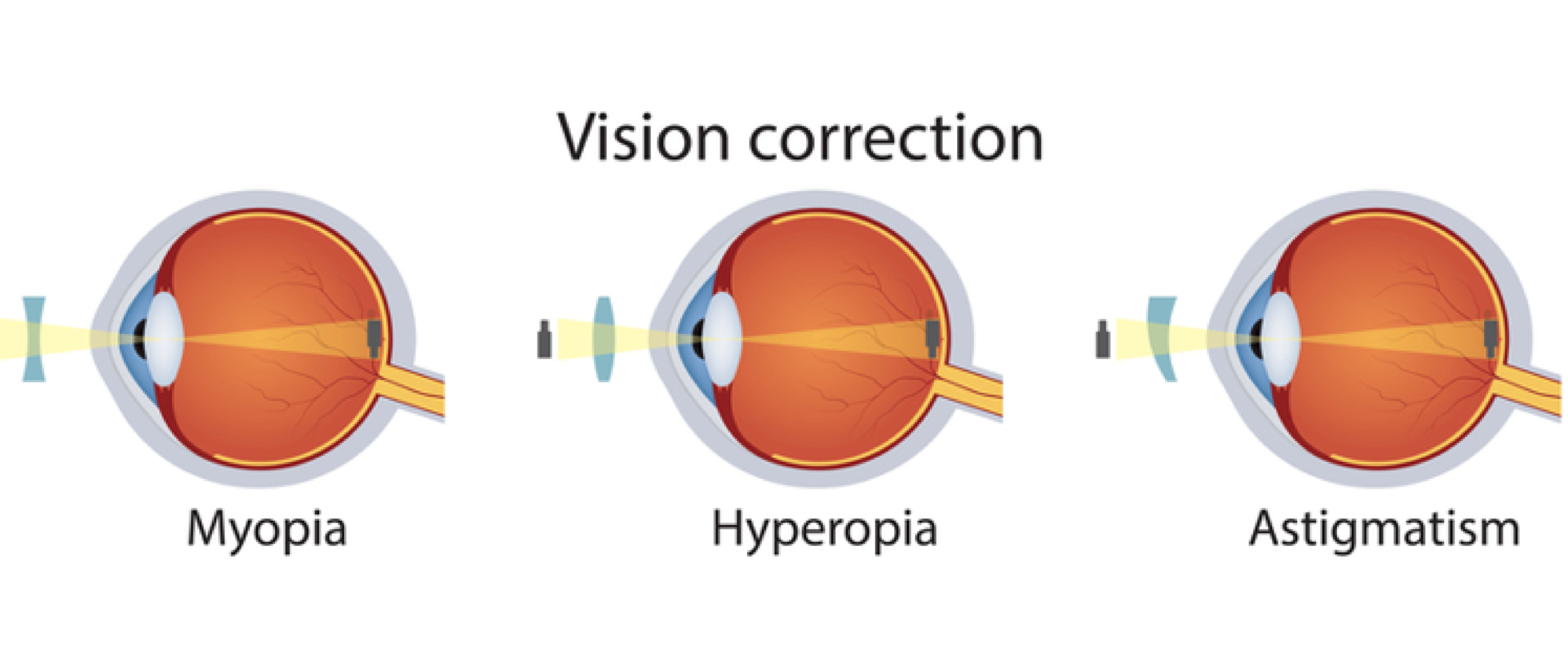
Myopia is the condition in which distant objects look blurry while near ones stay clear. The National Eye Institute describes it as a refractive error that makes far-away objects look blurry, and explains the cause: the eye focuses light in front of the retina rather than on it, most often because the eyeball has grown longer than it should have.
Picture the focusing system doing its job correctly but the retina sitting too far back to receive the sharp image. By the time the light reaches the retina, it has already come to a point and started spreading out again — so the image on the retina is a blur circle rather than a point.
Two features of myopia matter practically. First, it usually begins in childhood: the NEI notes that most types of refractive error, nearsightedness included, typically start in childhood, and it tends to progress while the eye is still growing. Second, because the underlying issue is frequently eyeball length rather than corneal shape, strong myopia can reach magnitudes that are demanding to correct. Jamsil Samsung Eye Clinic describes its vision correction specialty as treating myopia, hyperopia and astigmatism, including very high myopia.
The everyday presentation is familiar: road signs read late, faces unrecognizable across a room, cinema subtitles soft, squinting to sharpen distance vision. Many people discover it at school, when the board stops being legible from the back row.
Hyperopia: farsightedness
Hyperopia is the mirror image, and it is more often misunderstood. The National Eye Institute describes farsightedness as a refractive error that makes nearby objects look blurry, happening when the shape of the eye makes light focus behind the retina instead of on it. The NEI attributes it to an eyeball that has grown too short from front to back, or to problems with the shape of the cornea or the lens.
Here the light has not yet come to a focus by the time it reaches the retina; the sharp point would form somewhere behind the back of the eye, if the eye continued. The most common symptoms, according to the NEI, are trouble seeing things up close, eye strain — eyes feeling tired or sore — and headaches, especially when reading.
Two things distinguish hyperopia from the other errors. The first is that a young eye can partly compensate for it by using its own focusing muscles, which is why mild farsightedness often produces no symptoms at all until later in life. The NEI notes that most people who are farsighted are born with it, but that it may not cause vision problems until you get older. The strain of that constant compensation is often felt as fatigue rather than as blur, which is why hyperopia is sometimes discovered by a headache rather than by a vision chart.
The second is that in children it carries additional stakes. The NEI notes that children with severe farsightedness may be at higher risk for other eye problems, including crossed eyes and amblyopia, sometimes called lazy eye. That is a good argument for eye exams in childhood rather than waiting for a complaint.
Astigmatism: an uneven surface rather than a wrong distance
Astigmatism is a different kind of error. Myopia and hyperopia are about where the focus falls; astigmatism is about whether a single focus forms at all.
MedlinePlus describes astigmatism as a condition in which the cornea, or sometimes the lens, is curved unevenly — steeper in one direction than another — so that light entering the eye is not focused to one point. The FDA's glossary puts it as a distortion of the image on the retina caused by irregularities in the cornea or lens. The National Eye Institute notes that astigmatism can make both far-away and nearby objects look blurry or distorted.
The classic illustration is a ball versus an egg. A surface curved equally in every direction focuses light from all directions to the same point. A surface curved more steeply along one meridian than the one at right angles to it focuses those two meridians at different depths, and no single plane in the eye receives a sharp image. Vision is not uniformly blurred so much as smeared along a direction — which is why people with uncorrected astigmatism often describe letters as ghosted or streaked rather than simply soft, and why point sources of light at night can appear stretched.
Astigmatism very commonly accompanies myopia or hyperopia rather than occurring alone, which is why most prescriptions carry numbers for both. Whether an uneven curvature follows a clean, symmetrical pattern or a disordered one makes a meaningful difference to how well a lens can compensate for it, and that distinction is one of the things corneal mapping is used to establish. Jamsil Samsung Eye Clinic documents corneal topography among the examinations it performs, and its Ortho-K and refractive specialists list corneal evaluation among their areas of work.
Presbyopia: the one that is about time
Presbyopia is listed among refractive errors but behaves unlike the other three, and confusing it with farsightedness is one of the most common misunderstandings in eye care.
The National Eye Institute describes presbyopia as a refractive error that makes it hard for middle-aged and older adults to see things up close, caused by the lens inside the eye getting harder and less flexible so that it stops focusing light correctly on the retina. The NEI states that it is a normal part of aging, that everyone gets it — usually after age 45 — and that it usually stops getting worse after about age 65. The FDA glossary describes the same phenomenon as the inability to maintain a clear image as objects are moved closer, due to reduced elasticity of the lens with increasing age.
The distinguishing point is that presbyopia is a loss of adjustability, not a fixed error. Myopia, hyperopia and astigmatism describe an eye that is mis-focused in a constant way; presbyopia describes an eye that can no longer change its focus. The NEI notes explicitly that presbyopia is different from farsightedness, even though both make near work difficult, and that many people have another refractive error in addition to presbyopia. A person can be nearsighted and presbyopic at the same time — which is exactly the situation of the lifelong glasses wearer who, in their late forties, starts taking their glasses off to read.
How refractive errors are measured
The measurement is called a refraction. The FDA's glossary defines it as a test to determine the refractive power of the eye — and, in its second sense, as the bending of light itself, which is a neat reminder that the test is named after the thing it measures.
The National Eye Institute describes how the check is done as part of a comprehensive eye exam: the doctor asks you to read letters up close and far away, and may then use drops to widen the pupil in order to check for other eye problems. The exam is described as simple and painless. Jamsil Samsung Eye Clinic documents a detailed pre-surgical assessment that includes corneal topography, pupil-size measurement under different lighting conditions, and examinations of corneal health.
One preparation step matters enormously and is frequently overlooked: contact lenses temporarily reshape the corneal surface, so measurements taken too soon after wearing them describe a cornea that is not the eye's own. The FDA's patient checklist asks prospective surgical patients whether they can go for an extended period without wearing contact lenses before the evaluation. Jamsil Samsung Eye Clinic sets out its own intervals: soft lenses stopped seven days before, astigmatism-correcting soft or rigid gas-permeable lenses fourteen days before, and orthokeratology lenses one month before, so that the cornea returns to its natural shape before it is measured.
The unit of the result is the diopter. The FDA's glossary defines a diopter as the measurement of refractive error, and gives the sign convention directly: a negative diopter value signifies an eye with myopia, and a positive value an eye with hyperopia.
Reading the numbers on your prescription
A spectacle prescription is a compact description of what each eye needs. The columns are conventional, and once decoded they are readable by anyone.
- OD and OS. The abbreviations for the right eye and the left eye respectively, from the Latin oculus dexter and oculus sinister. Some prescriptions use RE and LE instead, and OU refers to both eyes.
- Sphere (SPH). The main correction, in diopters, applied equally in all directions. Following the FDA's convention, a minus figure indicates nearsightedness and a plus figure indicates farsightedness. A larger absolute number means a stronger correction.
- Cylinder (CYL). The additional correction needed in one direction only — in other words, the amount of astigmatism. A blank, a zero or a dash here means no measurable astigmatism.
- Axis. Present only when there is a cylinder value, and expressed as an angle between 1 and 180 degrees. It does not describe a strength; it describes where on the clock face the cylinder correction has to be applied. A cylinder without an axis is meaningless, which is why the two always travel together.
- Add. An additional plus power for near work, prescribed once presbyopia is in play. It is the number behind bifocal, progressive and reading prescriptions.
- Pupillary distance (PD). The distance between the centers of your pupils. The Federal Trade Commission notes that some states require this measurement to be included in the prescription and that it is needed to buy glasses online.
Two cautions are worth carrying. First, a spectacle prescription and a contact lens prescription are not interchangeable: a contact lens sits on the eye rather than in front of it, so the powers differ and the contact lens prescription also specifies the lens's own dimensions. Second, a prescription is a snapshot with an expiry, not a permanent property of your eyes.
Getting a copy of your own prescription
In the United States, you are entitled to this document, and the entitlement is not conditional on asking.
The Federal Trade Commission enforces what it calls the Eyeglass Rule, which requires eye doctors — both ophthalmologists and optometrists — to give patients a copy of their prescription whether they ask for it or not, and before offering to sell them eyeglasses. The FTC states that the prescription must be provided immediately after any refractive eye examination, regardless of the purpose of the examination and regardless of whether the refraction was billed separately. It also states that a practice cannot charge an extra fee for a copy of the prescription, cannot require the purchase of glasses or contact lenses in exchange for it, and cannot require the patient to sign a waiver or release as a condition of getting it.
The FTC notes that many states additionally require the prescription to carry the patient's name, the date of the examination or issue, the expiry date, and the prescriber's name, contact details and signature. Practically, that makes a prescription a dated record — and a collection of them over time is the most useful single document a patient can bring to any discussion of vision correction, because it shows not only what your eyes are but whether they have been changing.
The correction options, in outline
The National Eye Institute sets out three routes, and describes them in order of simplicity.
- Eyeglasses. The NEI calls these the simplest and safest way to correct refractive errors, with the eye doctor prescribing lenses to give the clearest possible vision. They correct by adding or subtracting focusing power in front of the eye — a minus lens for myopia, a plus lens for hyperopia, a cylindrical component set at a specified axis for astigmatism, and an add for presbyopia.
- Contact lenses. These sit on the surface of the eye and correct the same errors from a different position. The NEI notes that the eye doctor fits them and explains how to clean and wear them safely. A separate approach, orthokeratology, uses a rigid lens worn overnight to temporarily reshape the corneal surface; Jamsil Samsung Eye Clinic offers this as Dream Lens through its pediatric and lens clinic.
- Surgery. The NEI states that some types of surgery, including laser eye surgery, can change the shape of the cornea to fix refractive errors, and that your eye doctor can help you decide whether surgery is right for you. Other procedures place a corrective lens inside the eye instead of reshaping the cornea. Jamsil Samsung Eye Clinic documents both families, offering laser procedures including Clear Smile LASIK and LASEK alongside implantable collamer lens surgery.
This article deliberately stops at the outline. Which operation suits which eye is a separate discussion resting on measurements this article has only described in general terms.
Why the measurement comes before the conversation
There is a reason a responsible discussion of vision correction begins with numbers rather than with procedures.
The type of error determines what a correction has to accomplish. The magnitude determines how much work it is. The presence and pattern of astigmatism determine whether a simple spherical correction is even sufficient. The stability of the measurement over time determines whether it is sensible to correct anything permanently yet. And the health of the eye — which the same examination assesses — determines whether a refractive procedure is safe at all. The FDA's guidance for prospective surgical patients asks not only about the strength of the prescription but about corneal thickness, pupil size in dim conditions, tear production, medications and general health.
There is also a category of optical imperfection that no spectacle lens addresses. The FDA's glossary defines higher-order aberrations as refractive errors other than nearsightedness, farsightedness and astigmatism that cannot be corrected with glasses or contacts, and defines a wavefront measurement as a measure of the eye's total refractive error including those. This is part of why two people with identical written prescriptions can report different quality of vision, and why measurement is more informative than a number on a card.
Jamsil Samsung Eye Clinic states that the appropriate procedure is selected based on individual eye examination results, and that final eligibility for any vision correction procedure is determined by a comprehensive eye examination. If you want to discuss your own measurements with the clinic's team, that conversation begins through its contact page; the clinic's specialty lines and medical staff are described on its about page.
The Bottom Line
- Refractive errors are geometry, not disease: the National Eye Institute attributes them to eyeball length, corneal shape, and aging of the lens, and reports that more than 150 million Americans have one.
- Myopia focuses light in front of the retina and blurs distance; hyperopia focuses it behind the retina and blurs near work; astigmatism comes from unevenly curved optics and prevents a single sharp focus forming at all.
- Presbyopia is a loss of the lens's ability to change focus, arrives for everyone usually after age 45 according to the NEI, and is not the same thing as farsightedness.
- On a prescription, sphere is the overall power with a minus sign for myopia and a plus for hyperopia, cylinder is the amount of astigmatism, and axis states the direction the cylinder applies to.
- The Federal Trade Commission requires US eye doctors to hand you a copy of your prescription after a refractive examination without being asked, and to do it before offering to sell you glasses.
Frequently Asked Questions
What is the difference between myopia and hyperopia?
They are opposite mismatches between the eye's focusing power and its length. The National Eye Institute describes myopia as light focusing in front of the retina, making far-away objects blurry, usually because the eyeball grew too long. Hyperopia is light focusing behind the retina, making nearby objects blurry, usually because the eyeball is too short front to back.
Can I have more than one refractive error at the same time?
Yes, and it is very common. Astigmatism frequently accompanies either nearsightedness or farsightedness, which is why most prescriptions carry both a sphere and a cylinder value. The National Eye Institute also notes that many people have another refractive error in addition to presbyopia, so a lifelong glasses wearer can develop near-vision difficulty on top of an existing prescription.
What does the minus sign on my prescription mean?
It identifies the direction of the correction. The FDA's patient glossary states that a negative diopter value signifies an eye with myopia and a positive diopter value signifies an eye with hyperopia. The size of the number indicates how strong the correction is, and the diopter is the standard unit for measuring refractive error.
What causes astigmatism?
Uneven curvature of the eye's optics. MedlinePlus describes the cornea, or sometimes the lens, being curved more steeply in one direction than another, so that light is not brought to a single point. The FDA describes the result as a distortion of the image on the retina caused by irregularities in the cornea or lens, which is why vision appears smeared or ghosted rather than evenly soft.
Is presbyopia the same as farsightedness?
No, and the National Eye Institute makes the distinction explicitly. Farsightedness comes from the shape of the eye and is usually present from birth. Presbyopia comes from the lens inside the eye becoming harder and less flexible with age, so it loses the ability to change focus. Both make close work harder, but for different reasons.
Why do I have to stop wearing contact lenses before an eye measurement?
Because a contact lens temporarily changes the shape of the corneal surface, so measurements taken too soon describe the lens's effect rather than your eye. The FDA asks prospective surgical patients whether they can go without lenses for an extended period beforehand. Jamsil Samsung Eye Clinic specifies seven days for soft lenses, fourteen for rigid gas-permeable or astigmatism-correcting soft lenses, and one month for orthokeratology lenses.
How often should I have my eyes measured?
The National Eye Institute recommends regular eye exams because some people do not notice the symptoms of refractive errors at all, and advises asking your doctor how often you should be checked given your own risk. If you already wear glasses or contact lenses and still have blurred vision, headaches or eye strain, the NEI suggests you may need a new prescription.
This article is for general informational purposes and does not constitute individualized medical advice. It is not a self-diagnosis tool. Surgical candidacy, technique, and expected outcomes can only be determined through a consultation with a qualified ophthalmologist.
More Articles
Continue reading our clinical ophthalmology guides.

LASIK Cost Korea vs US: How Each System Sets Prices
LASIK cost in Korea vs the US differs because each system treats vision correction as elective. How pricing is structured, and how to request a real quote.
Learn More

Dr. Kim Byoung Jin: Ophthalmologist in Seoul, Korea
Dr. Kim Byoung Jin is a board-certified ophthalmologist and representative director at Jamsil Samsung Eye Clinic, Seoul. His training and focus, explained.
Learn More

Book an Online Consultation: Korea Eye Clinic Guide
Book an online consultation with a Korea eye clinic: the channels this Seoul practice documents, the time-zone arithmetic, and what to assemble up front.
Learn More