Specialized Ophthalmology in Seoul · Dedicated International Patient Concierge
MOHW Registered · Foreign Patient Care
en-US


Medical Guide
Hidden Costs LASIK Abroad: What to Ask Before Booking
Planning eye surgery in South Korea? The cost categories a clinical quote does not cover, and the questions to put to a clinic in writing before you book.
Schedule a ConsultationWhat to Ask Before Booking Eye Surgery in South Korea
Medically reviewed by Dr. Kim Byoung Jin, Board-certified ophthalmologist (Korean Ophthalmological Society)
If you searched "hidden costs LASIK abroad," this article will disagree with the phrase and then answer the question underneath it. Nothing in the public record suggests that Jamsil Samsung Eye Clinic, or Korean eye clinics generally, conceal charges. What is true of every cross-border medical trip is that a clinical quote prices clinical services, while a trip involves a great deal that is not clinical. Hotel nights, a changed return date, care once you land at home: none of that belongs on a surgeon's price list, and none of it stops existing because it was left off one. So this is a list of ordinary planning categories rather than red flags, each turned into a question to put to a clinic before you commit.
Why this article names no amounts
The gaps this article cares about are not price gaps. Jamsil Samsung Eye Clinic has published no enhancement policy, no required length of stay and no arrangement for care once a patient has gone home, so the contingency terms that decide what a trip really costs are not on the record — and no figure is attached to them either.
That is why every category below arrives as a question rather than an answer.
What a quote prices, and what a trip involves
A clinical quote is a price for clinical work — what a clinic is qualified to price. A medical trip is a larger object. The clinic's US-market documentation describes what patients traveling from the United States should plan for: a preoperative assessment, the surgery, postoperative review, accommodation, transportation, and enough time in Korea for whatever follow-up proves necessary. Four of those six are logistics — still costs, simply not medical ones, and yours to arrange.
The US Department of State makes the boundary explicit: the US government does not pay travelers' medical bills abroad, and travelers carry their own costs. No consular fund absorbs a longer stay or an unexpected complication.
Enhancement: the question that changes when you live overseas
An enhancement, sometimes called a retreatment, is a further procedure performed after an initial vision correction to adjust a result that landed short of the target — a small residual refractive error, or a correction that has drifted, which clinicians call regression.
This is a recognized part of refractive surgery rather than an anomaly. The FDA's patient information on LASIK is direct about the procedure's limitations: results are not guaranteed to be permanent, some people still need glasses afterward, and vision can change over time. The National Eye Institute frames refractive surgery the same way, and the American Academy of Ophthalmology's patient material sets candidacy and risk out as an individual assessment rather than a general verdict. The clinic's own material lists residual refractive error requiring enhancement among the general risks, alongside dry eye, glare and halos, and infection. How often it happens is not something this article will estimate; no such figure is published.
Here is why the question sharpens when you live in another country. If you have surgery near home and need an adjustment, you go back. From the United States, going back means an international flight, time off work and a hotel again, so the policy matters more than the price:
- Is enhancement included in the quoted procedure, or billed separately?
- If it is included, for how long after the original surgery does that hold?
- Does the inclusion cover only the procedure, or the re-examination that decides whether it is appropriate?
- If you cannot return to Korea, will the clinic release records so another surgeon can assess you?
The clinic has not published an enhancement policy, so none of these has a public answer. Ask in writing.
When healing takes longer than the plan
Healing is biological, and biology varies between people. Surface procedures depend on the corneal epithelium — the cornea's outer layer — regenerating at its own pace, and no surgeon clears an eye for a long flight before that is under way.
The clinic records the duration and visit requirements for its vision correction specialty as needing confirmation, so the honest position is that the required length of stay is unpublished. It is not hidden; it depends on which procedure you turn out to be a candidate for. That makes it a question for your consultation rather than something to infer from a search result.
The planning consequence is straightforward. If a postoperative check finds healing slower than expected, the surgeon may want you in Seoul longer — extra nights and a changed flight, both at your expense, as the State Department confirms. Two practical responses: ask for a realistic outer bound on the stay for your likely procedure, and check what a changeable return fare costs at booking rather than at the point of changing it.
Flying home is a clinical decision, not a scheduling preference
The Centers for Disease Control and Prevention's Yellow Book chapter on medical tourism records that air travel soon after an operation carries an elevated risk of blood clots. That is not an abstraction on this route: a flight between Seoul and the continental United States is long, and nearly all of it is spent seated.
The same chapter asks travelers to line up their aftercare at home in advance of departure rather than on return. Its reasoning is the sentence a cost-conscious reader should sit with longest: not every doctor or insurer in the United States is willing to take responsibility for a problem that traces back to an operation performed in another country. Read that as a budgeting instruction rather than a warning. If the answer at home is no, the cost of managing anything that goes wrong lands on you — after the Seoul quote has already been settled.
Your return date is not a preference you set when you book. It is a clinical judgment your surgeon makes after examining your eye, and the clinic's documented position is exactly that — patients should fly only once the treating ophthalmologist confirms the eye is stable and recovery is progressing normally. If that judgment lands later than your itinerary assumed, the itinerary changes. That makes a change fee a foreseeable planning item: before booking, find out what your airline charges to move a return, and decide whether flexibility is worth buying up front.
Follow-up after you land
This is a live patient concern rather than a hypothetical. Among the questions the clinic records American patients asking most often are whether follow-up is available after returning home, and what happens if a complication develops once they are back.
What it has not published is a remote follow-up protocol — no schedule of check-ins from overseas, no stated arrangement with US providers. It does document remote channels: telephone consultation, online reservation, email reply requests. Those are contact methods, not a care plan.
Time zones make the gap concrete. The clinic's consulting hours are:
- Monday through Thursday, 09:30–19:00 KST
- Friday, 09:30–20:00 KST
- Saturday, 09:00–13:00 KST
- Lunch 13:00–14:00 KST, and closed on Sundays and public holidays
The distance between Seoul and the continental United States runs from thirteen to seventeen hours, a spread covering Eastern through Pacific time and shifting twice a year with daylight saving. A question sent on a Tuesday evening in Chicago lands in the middle of the Korean night; one sent late on a Saturday afternoon in California waits until Monday morning in Seoul. For a routine query that is a mild inconvenience: write clearly, include everything, expect an answer tomorrow. For "my eye is suddenly painful at two in the morning," it is not a system at all, and no goodwill at the clinic's end changes the clock.
So the cost question here is really three: who provides your follow-up examinations once you are home, who pays for them, and how the two clinicians would communicate. The third is most often skipped, and it is the one you can settle cheaply in advance. What a doctor in the United States needs in order to pick up your care is short, specific, and far easier to collect in Seoul than to request later:
- The operative record: which procedure was performed, on which eye, and on what date.
- The measurements the surgical plan was built from, including the pre-operative refraction and corneal data.
- Implant details if a lens was placed — model, power, and the lot or serial reference.
- The post-operative medication schedule, with drug names rather than brand names alone, and the date the course ends.
- Findings from your final examination before departure, as the baseline a doctor at home compares against.
- A named contact at the clinic, and the language that contact works in.
Ask for it in English, or with a translation attached, and ask before your last appointment rather than during it.
The other half of the arrangement is the doctor at home, and that conversation belongs before the trip. Describe the procedure you expect to have, ask whether they will provide follow-up for surgery performed overseas, and ask what they would charge. Both answers are useful, and only one is expensive to discover late.
Language support: documented in outline, unconfirmed in the specifics
The clinic documents in-house English support across inquiry, consultation, surgery day, aftercare and emergency contact, states that translated documents are available, and records no language limitations on its patient services. That is a reasonable starting point.
What is not on the record is the detail. Three things sit unconfirmed in its own files: who the international coordinator is and when they are available, how language is handled in the consultation room, and what support exists for aftercare and emergencies. The clinic's review process goes further, instructing that the level of English support be verified before any claim about it is published here.
Take that at face value. Nothing in the documentation says interpretation is charged for, and this article will not suggest that it is. But the unverified part is the working detail — and the working detail is what you rely on at 08:00 on surgery morning. Ask which parts of the day run in English, who is present for the consent conversation, and how to reach someone after hours.
Getting to the clinic and staying near it
Jamsil Samsung Eye Clinic is on the seventh floor of the Seokyeong Building, 114 Olympic-ro, Songpa-gu, Seoul 05558, near Jamsil-saenae Station. Whether airport transfer is arranged, included or left to the patient is not documented either way, which makes it a question rather than an assumption.
Accommodation deserves the same treatment. You will make more than one trip to the clinic — examination, surgery, at least one postoperative check — and dilating drops leave the eyes light-sensitive afterward. Neither dilation nor a freshly operated eye pairs well with a long unfamiliar commute, so price a room near Songpa-gu before booking a cheaper one an hour away.
How and when payment is taken
Payment options for the US market are recorded as needing confirmation, and that one line has several consequences. Public information does not tell you which methods the clinic accepts, whether a deposit holds a surgical date, whether it is refundable if the examination finds you unsuitable, or when the balance falls due. Each is a normal commercial arrangement clinics differ on, and each affects when money leaves your account, not only how much.
Currency belongs on the same list, and it is a timing question more than an arithmetic one. What a quote converts to at home moves between the day it is issued and the day you settle it, so the amount you budgeted against is not necessarily the amount that leaves your account. Ask the clinic which currency it quotes in and which it takes payment in, ask your card issuer how it handles the conversion, and send those questions through the clinic's contact page, its listed primary channel for this market.
Insurance, in one paragraph
Care received abroad sits outside Medicare in all but a narrow set of situations, which Medicare.gov spells out; it adds that some Medigap policies extend to emergency treatment overseas, and that travel insurance is the usual substitute. Tax treatment is a separate subject, covered elsewhere in this library. The planning point that belongs here is narrower: whatever cover you carry, establish before departure whether it would respond to a complication of an elective procedure performed abroad. That one answer decides who absorbs most of the contingencies above.
Questions to put in writing before you book
Send these as a single written list and keep the reply. A written answer is something you can hold a plan to; a phone call across a large time difference is not.
- Is enhancement or retreatment included in the quoted procedure? If so, for how long, and does it cover the re-examination?
- If I cannot return to Korea for an enhancement, will you release my records to another ophthalmologist?
- What is a realistic outer bound on my stay, and what would make you want me to stay longer?
- What follow-up do you expect after I return home, who would provide it, and what records will I take with me?
- How quickly do written inquiries from the United States receive a reply, and is there an after-hours route for an urgent problem?
- Which parts of the consultation, surgery day and aftercare run in English, and which documents will I receive in English?
- Is airport or clinic transfer arranged, and do you help with accommodation near Songpa-gu?
- What payment methods do you accept, is a deposit required, is it refundable if I am found unsuitable, and in which currency is payment taken?
Background on the practice and its four named ophthalmologists is on the clinic's about page. One item you can check without asking: its registration to treat patients from abroad appears on Medical Korea, the official foreign-patient portal — a status that says the clinic may lawfully take you, and nothing about quality.
The Bottom Line
- A clinical quote prices clinical services. Accommodation, transportation, a changed return date and care once you are home are ordinary parts of a medical trip; asking about them is planning, not suspicion.
- Enhancement policy matters more when you live overseas, because returning is a flight rather than a drive — and the clinic has published no such policy.
- Line up your aftercare in the United States before departure. The CDC records that not every American clinician or insurer will take on a problem stemming from surgery done elsewhere, and that clot risk rises when a long flight follows an operation closely.
- English support is documented in outline but unconfirmed in the specifics, the required stay is unpublished, and payment options are unconfirmed. Get all three in writing before you book.
Frequently Asked Questions
What is an enhancement procedure, and why does it matter more if I live overseas?
An enhancement, or retreatment, is a further procedure to adjust a result that settled short of the target, whether from residual refractive error or later regression. The FDA notes that LASIK results are not guaranteed to be permanent. Returning from the United States means another international trip, so confirm the policy on inclusion and time limits first.
How soon after vision correction surgery can I fly home?
That is a clinical decision your surgeon makes after examining the eye, not a date you fix in advance. The clinic's documented position is that patients should fly only once the treating ophthalmologist confirms the eye is stable and recovery is progressing normally. The required stay is recorded as needing confirmation, and the CDC notes that air travel soon after surgery raises clot risk.
How would my surgeon in Seoul and an eye doctor at home share information about my case?
The clinic has not published a remote follow-up protocol, so there is no documented arrangement to describe. It does document that translated documents are available and that it operates telephone, online and email channels. Before leaving Korea, ask which records and prescriptions you will take home, and in what language.
Does Medicare pay for anything if a problem develops while I am in Korea?
Almost certainly not. Medicare.gov places care received abroad outside the program apart from a few narrow situations, and points toward Medigap policies covering emergency treatment overseas, or travel insurance, as the usual substitute. The US Department of State separately confirms that the US government does not pay travelers' medical bills abroad.
How long might the clinic take to answer a message sent from the United States?
The clinic has published no target for reply times, so treat the clock as the constraint: its consulting day, listed above, falls almost entirely outside US business hours, and messages sent during an American working day generally wait overnight. Send one complete written inquiry rather than several partial ones, so the first reply can be substantive.
Should I book a flexible return flight?
That is a personal judgment, but the information you need is knowable in advance. Because the required stay is unpublished and clearance to fly depends on how your eye heals, a fixed return date carries a real chance of needing to move. Ask the clinic for a realistic outer bound first.
This article is for general informational purposes and does not constitute individualized medical advice. Surgical candidacy, technique, and expected outcomes can only be determined through a consultation with a qualified ophthalmologist, and this article is not a self-diagnosis tool.
More Articles
Continue reading our clinical ophthalmology guides.
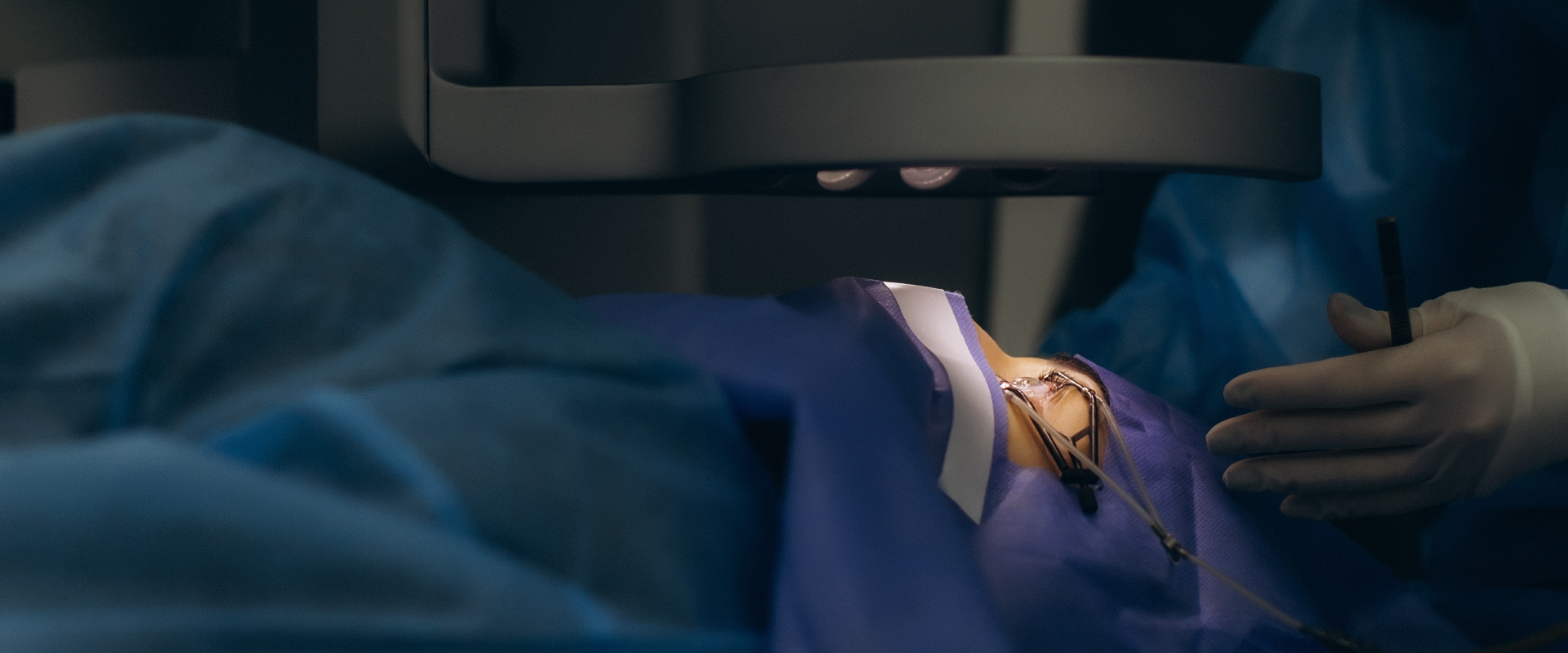
LASIK Cost Korea vs US: How Each System Sets Prices
LASIK cost in Korea vs the US differs because each system treats vision correction as elective. How pricing is structured, and how to request a real quote.
Learn More
Dr. Kim Byoung Jin: Ophthalmologist in Seoul, Korea
Dr. Kim Byoung Jin is a board-certified ophthalmologist and representative director at Jamsil Samsung Eye Clinic, Seoul. His training and focus, explained.
Learn More

Book an Online Consultation: Korea Eye Clinic Guide
Book an online consultation with a Korea eye clinic: the channels this Seoul practice documents, the time-zone arithmetic, and what to assemble up front.
Learn More