Specialized Ophthalmology in Seoul · Dedicated International Patient Concierge
MOHW Registered · Foreign Patient Care
en-US

Medical Guide
Clear Smile LASIK Cost: How Its Price Tier Is Decided
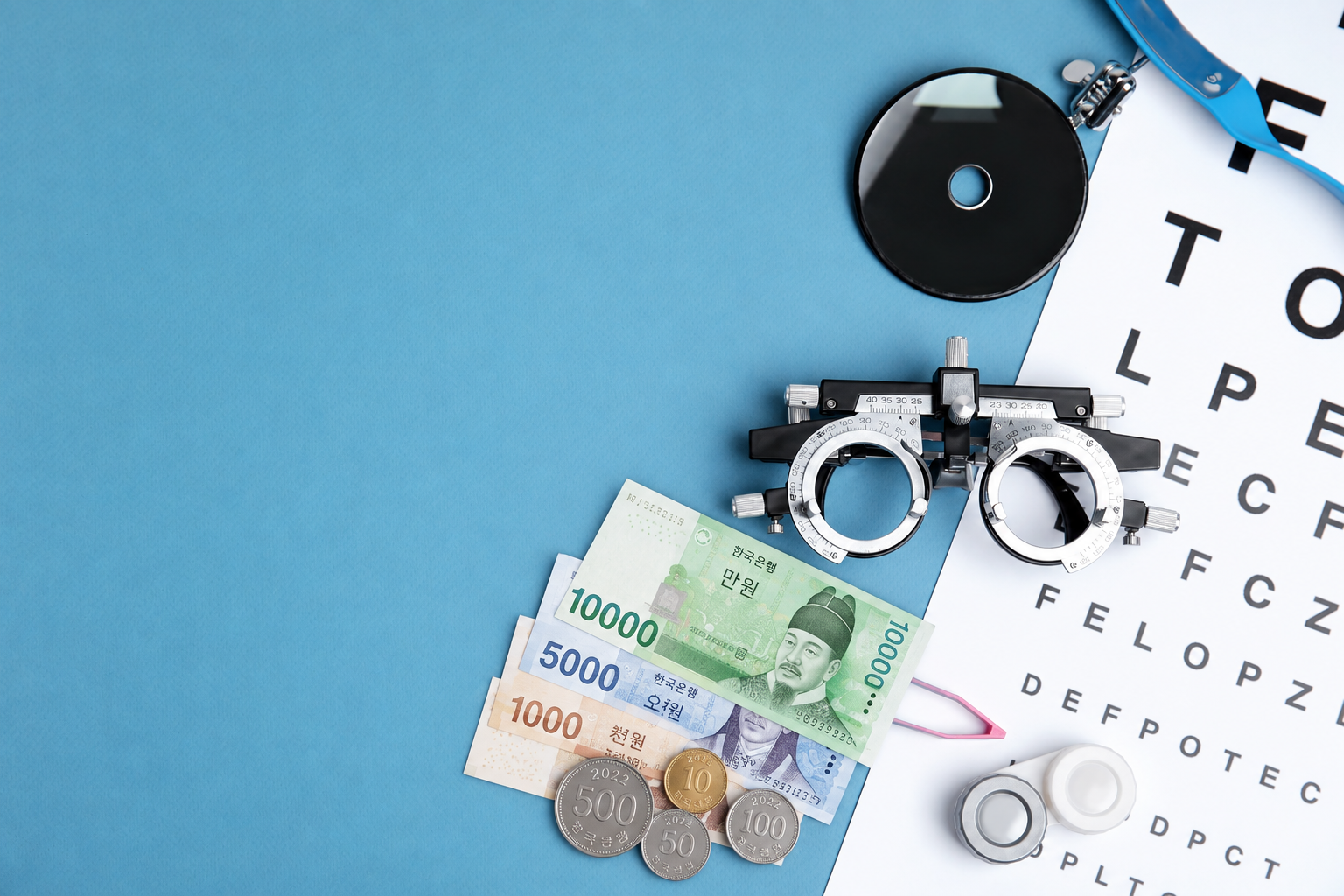
Clear Smile LASIK cost sits in its own tier because the name marks one laser platform. How tiering works, and the questions that turn a tier into a number.
Schedule a ConsultationClear Smile LASIK Cost: How a Technology Name Becomes a Price Tier
Medically reviewed by Dr. Kim Byoung Jin, Board-certified ophthalmologist (Korean Ophthalmological Society)
A quoted Clear Smile LASIK cost is a tier before it is a number: it tells you which machine and which surgical maneuver you are buying, not what any national schedule says that work is worth. Jamsil Samsung Eye Clinic publishes nothing about prices, and since the price fields in the clinic's own documentation are awaiting confirmation, the tier exists on the record while the number does not — so no price appears below. What appears instead is the anatomy of a tier: what the name designates, what the equipment does, what changes surgically, and which questions turn a tier into a number you can compare.
What does the name "Clear Smile LASIK" actually designate?
Begin with what kind of word it is. "LASIK" names a family of operations performed worldwide on many different machines. "Clear Smile LASIK" names one specific technique on one manufacturer's platform, described in one clinic's materials.
The clinic documents Clear Smile LASIK as flapless lenticule extraction performed with the Ziemer FEMTO LDV Z8 femtosecond laser. The laser shapes a thin disc of tissue — a lenticule — inside the cornea. That disc is drawn out through an incision the clinic describes as approximately 2 mm, and the cornea's front curvature changes as a result.
The underlying family is recognized: in the National Eye Institute's account, refractive surgery either alters corneal shape or adds a lens inside the eye so that incoming light lands correctly on the retina, and the NEI cautions that outcomes are not uniform between patients. The proper noun sits a level below that description — same category of operation, one particular platform and workflow.
Nothing standardizes those proper nouns. No regulator or professional society keeps a master list of brand names with agreed definitions, so such names travel with equipment and marketing rather than with a published taxonomy. The clinic's own comparison material makes the family relationship explicit, grouping SMILE and Clear Smile together as methods that create a lenticule and remove it through a small incision.
Clear Smile versus SMILE, then, is mostly a question about which platform and planning software sit behind the same basic maneuver. Matching name to name proves nothing; you have to match technique to technique and platform to platform before comparing what each clinic is charging for.
The device underneath the tier: the Ziemer FEMTO LDV Z8
A tier named after a technique is, commercially, a tier named after a machine. Four documented properties of the Z8 do the work.
It is a femtosecond laser. A femtosecond is a quadrillionth of a second, and pulses that short deposit their energy faster than heat can spread into surrounding tissue. The beam is focused to a point beneath the corneal surface, where each pulse vaporizes a microscopic pocket of tissue and separates the layers at that exact depth. Thousands of adjacent pockets, placed along a computed path, add up to a continuous cleavage plane.
Real-time OCT imaging is built in. Optical coherence tomography uses reflected light to produce cross-sectional images of tissue. Integrated into the laser, it lets the surgeon watch the corneal stroma, the docking status, the pupil position and the designated lenticule range while the procedure runs, not only on a scan taken beforehand. Its function is live verification that the plan is landing at the depth and position intended.
The docking interface is customized. Docking is the moment the laser is coupled to the eye. The clinic documents a custom docking interface meant to prevent displacement of the eye — the precondition for everything else, because if the globe shifts relative to the laser's coordinates, a plan computed to micrometer tolerances lands somewhere other than intended.
Pulse energy is low and pulse frequency is high. Lower energy per pulse means a smaller disruption at each spot, so pulses sit closer together and the resulting surface is smoother; the clinic notes minimal gas bubble formation, gas being a byproduct of vaporization that can scatter later pulses. A high repetition rate keeps treatment time short despite the far greater number of pulses required.
One further capability belongs here, because it is where custom astigmatism correction happens. Astigmatism means an unevenly curved cornea, so light does not focus to a single point. The clinic corrects it in Clear Smile by rotating the position in which the lenticule is generated to match the axis of the patient's astigmatism, and documents automated astigmatism axis alignment for Z8 Premium LASIK.
Flap or flapless: what actually differs on the operating table
The phrase minimally invasive LASIK gets used loosely. Here is the concrete difference between the two approaches.
In flap LASIK, the surgeon creates a hinged flap in the front of the cornea, lifts it aside like a page still attached at the spine, applies the excimer laser to the exposed tissue beneath, and then replaces the flap. The flap is a door: made, opened, closed and left to seal.
In a flapless lenticule technique, no door is made. The laser works entirely inside the cornea to define the lenticule, and the only opening is the approximately 2 mm entry through which the tissue is withdrawn — which is why the approach is also described as small incision LASIK. The clinic's documented sequence: create the lenticule, remove it through the small incision, corneal shape changed.
Three consequences follow. There is no flap, so nothing can later be displaced. The front surface is opened over a much smaller area, and the clinic markets Clear Smile to people concerned about pain or dry eye and to those who cannot take extended leave — its rationale for offering the technique, not a promised result. And it is documented as suitable for high myopia and high astigmatism, a candidacy statement rather than a quality claim.
None of that removes risk. The clinic lists dry eye, glare, halos and residual refractive error among the possible outcomes of Clear Smile LASIK. The US Food and Drug Administration's LASIK material makes the same points from the regulator's side: candidacy is limited, persistent dry eye and night-vision symptoms are recognized risks, and outcomes differ between patients. A smaller opening changes the route; it does not make an elective operation risk-free.
Why a platform-named procedure gets its own line item
Several structural forces push a named technique toward being priced on its own.
The equipment is a distinct asset. A femtosecond laser with integrated imaging is purchased, serviced, calibrated and eventually replaced as its own item. A clinic that also runs an excimer laser for surface treatments and performs implantable lens surgery is operating several production lines, not one.
The technique is not substitutable at will: measurements decide whether a flapless method is available to you, so procedures are not interchangeable inventory sold at one rate.
And nothing external forces a common name. In Korea, refractive surgery is classified as cosmetic and elective and billed as non-covered general care, so no public schedule supplies a shared reference point that would push every clinic to describe the work identically.
The practical result is price by technology type: a tiered menu in which each named technique carries its own line rather than one blended "laser eye surgery" total. That is more honest in one way, since a single number cannot conceal several clinically different operations, and harder to shop in another, since you cannot line up totals until you know which technique each one assumes — and only itemization reveals which. Note also what a tier name never tells you: it identifies equipment and technique, not what surrounds them in the quote.
What the examination settles before any tier can apply
A tier is a conditional statement. The condition is candidacy, and the clinic settles it with a comprehensive eye examination lasting approximately two hours. Several distinct measurements happen inside it.
Corneal topography charts curvature across the whole front surface rather than taking one central reading, which is how an irregular or progressively thinning cornea gets caught.
Pupil size is measured under different lighting conditions, because a pupil that opens widely in the dark can extend past the treated zone and contribute to glare and halos at night.
Corneal thickness and overall eye health are assessed, because tissue removal has a budget: a lenticule technique takes tissue from inside the stroma, and the cornea has to retain enough structural material afterward.
Two further criteria are documented at the specialty level: refractive stability for approximately six months, and age eighteen or over. A prescription still drifting will drift after surgery too.
The examination does not confirm a choice you have already made; it establishes which techniques are on your list at all. Anatomy, not preference, sets that list, and the tier you end up discussing follows from what the measurements show. The clinic notes the limits plainly: surgery cannot prevent presbyopia, some regression is possible, results vary. The National Eye Institute makes the same point about age-related change continuing regardless of refractive surgery. If you want that examination scheduled before you commit to travel, contacting the clinic is the step that starts it.
The range of techniques this clinic documents, as a structure
The clinic's vision-correction record contains five distinct approaches. Read this as a map of clinically different routes, not a ranking; which route suits an eye is settled by examination at the practice, led by its representative director with four ophthalmologists in the group.
- Clear Smile LASIK. Flapless lenticule extraction with the FEMTO LDV Z8, an incision of approximately 2 mm, no corneal flap, custom docking, real-time OCT monitoring during the procedure, and astigmatism correction oriented by rotating the lenticule-generation position to the astigmatism axis.
- Z8 Premium LASIK. Also built on the Z8 and also using an approximately 2 mm micro-incision, with real-time OCT guidance, automated astigmatism axis alignment, low pulse energy, high pulse frequency and minimal gas bubble formation. Topical anesthetic drops are used, laser time is a few minutes per eye, and most patients are documented as returning to light daily activities within three to four days. It can be combined with corneal cross-linking for thin corneas or high myopia.
- High Premium LASEK. A surface technique. The epithelium — the cornea's outermost layer — is removed, an excimer laser reshapes the tissue underneath, and a protective contact lens is placed while the epithelium regenerates. The clinic's SMART program includes Mitomycin to reduce corneal haze and myopic regression. It is documented for some thin corneas and for moderate-to-high myopia, and as resistant to external impact with no flap-displacement complications. Recovery is staged over days, weeks and months.
- Corneal Strengthening LASEK. LASEK combined with cross-linking. The laser reshapes part of the stroma, riboflavin — vitamin B2 — is applied and absorbed, the excess is rinsed away, and ultraviolet-A light is applied so new bonds form between collagen fibers and stiffen the tissue. The clinic documents roughly fifteen minutes for the laser step and roughly twenty including cross-linking.
- Implantable lens surgery. No corneal tissue is removed or reshaped. A lens is placed inside the eye, between the natural lens and the iris, and the toric version is aligned to the astigmatism axis. The clinic presents this route for very high myopia and corneas too thin for laser treatment, and lists risks including raised eye pressure, inflammation, cataract formation, endothelial cell loss and lens displacement. Nothing in the record establishes the approval status of the particular lens model used here, so raise that with the clinic directly.
These are not variants of one product. They differ in what tissue is touched, what device does the work, and which eyes they suit.
How to compare brand-named procedures across clinics
Brand names defeat comparison shopping unless you translate them first. Translation means asking every clinic the same technical questions and setting the answers side by side: which generic family the operation belongs to, whether a corneal flap is created, how large the opening is, which laser model performs each step, how astigmatism is handled, and what imaging guides the procedure. Two quotes describe the same operation only when those answers match.
Read promotional language with a specific test in mind. The Federal Trade Commission's health products compliance guidance holds that health-related claims must be truthful and adequately substantiated, and that material qualifications have to be disclosed clearly rather than buried. Applied to a page advertising a named technique, that yields two questions. What evidence stands behind a claim that this technique is gentler or more precise than another? And is the qualification — that it applies only to patients who turn out to be suitable — stated where a reader will see it?
Credentials deserve the same translation. Board certification is granted nationally; the Korean Ophthalmological Society certifies ophthalmologists in Korea, and its certificate is not the same instrument as an American one. Membership in a specialty organization such as the American Society of Cataract and Refractive Surgery signals participation in the field's professional life, which is context rather than a credential. Both are checkable; neither replaces the other.
Finally, weigh the cross-border dimension honestly. The CDC's Yellow Book chapter on medical tourism identifies communication difficulties, variation in standards between facilities, gaps in continuity of care, and complications that surface only after the patient has flown home; it also notes that air travel soon after surgery raises the risk of blood clots. Those factors belong in the comparison alongside the technique.
The questions that convert a tier into a number
Send these in writing and keep the replies. Together they turn a technology tier into a figure you can evaluate.
- Which procedure name are you quoting, and which generic technique does it correspond to?
- Which laser model performs each step, and is a corneal flap created at any point?
- What examination findings would move me out of this tier, and which technique would replace it?
- Is the quoted amount conditional on the examination, and what happens if my candidacy changes?
- Is the price given per eye or for both eyes?
- Which items are inside the quote and which are billed separately?
- If astigmatism correction or cross-linking is added, is that a separate charge?
- What currency is the quote in, and when is payment taken?
- Which parts are refundable if the examination rules out surgery?
- Who is the operating surgeon, and is that person named in the quote?
The Bottom Line
- "Clear Smile LASIK" designates a flapless lenticule technique performed on the Ziemer FEMTO LDV Z8, not an industry-standard category — it identifies a platform and a tier, never a market rate.
- The tier reflects real mechanical differences: femtosecond pulses working inside the cornea, integrated real-time OCT verification, a custom docking interface, low pulse energy at high frequency.
- The clinic documents five clinically distinct routes and no price for any of them; candidacy, settled by an approximately two-hour examination, decides which routes are available to you.
- Comparable quotes require translated names: same generic technique, same platform, same flap question, same inclusions, same currency, same surgeon.
Frequently Asked Questions
Is Clear Smile LASIK the same procedure as SMILE?
They belong to the same family. The clinic's comparison material groups SMILE and Clear Smile together as techniques that create a lenticule inside the cornea and remove it through a small incision, distinct from flap LASIK and from surface treatments. The clinic's version is documented as performed with the Ziemer FEMTO LDV Z8, so ask any clinic which platform its name refers to.
Does a flapless technique always sit in a higher tier than flap LASIK?
Not as a rule, and no figures appear here to test it against. Tiering follows equipment, consumables, surgical time and the aftercare a clinic counts as part of the episode, and those inputs differ by provider. Korean law also treats refractive surgery as elective and non-covered, so no public schedule anchors the comparison.
Can I get a Clear Smile LASIK price before I travel?
You can ask, and should ask in writing, but treat any answer as conditional. Jamsil Samsung Eye Clinic has not published prices, and the cost fields in its documentation are recorded as needing confirmation. Ask which procedure the quote assumes and what it becomes if the examination points elsewhere.
What happens if the examination rules Clear Smile LASIK out?
Then a different route is discussed. Corneal thickness, regularity, refractive stability and overall eye health can direct a patient toward a surface technique such as LASEK, toward LASEK with cross-linking, or toward an implantable lens. Ask before booking travel which alternatives the clinic would propose.
Does the small incision mean I will not get dry eye?
No. The clinic lists dry eye among the possible outcomes of Clear Smile LASIK, alongside glare, halos and residual refractive error, and the FDA identifies persistent dry eye and night-vision symptoms as recognized risks of laser vision correction. The clinic markets the technique to patients concerned about dry eye, which states intent rather than result.
How long does Clear Smile LASIK take, and how many visits does it need?
The clinic does not publicly specify the surgical duration or the number of visits for Clear Smile LASIK, and the required length of stay is unpublished as well, since it varies with whichever technique your examination points to. For Z8 Premium LASIK it does document laser time of a few minutes per eye and light daily activities within three to four days. Ask for your own schedule in writing.
This article is for general informational purposes and does not constitute individualized medical advice. Candidacy, technique, and expected outcomes can only be determined through an in-person examination and consultation with a qualified ophthalmologist. It is not a self-diagnosis tool.
More Articles
Continue reading our clinical ophthalmology guides.
LASIK Cost Korea vs US: How Each System Sets Prices
LASIK cost in Korea vs the US differs because each system treats vision correction as elective. How pricing is structured, and how to request a real quote.
Learn More
Dr. Kim Byoung Jin: Ophthalmologist in Seoul, Korea
Dr. Kim Byoung Jin is a board-certified ophthalmologist and representative director at Jamsil Samsung Eye Clinic, Seoul. His training and focus, explained.
Learn More

Book an Online Consultation: Korea Eye Clinic Guide
Book an online consultation with a Korea eye clinic: the channels this Seoul practice documents, the time-zone arithmetic, and what to assemble up front.
Learn More